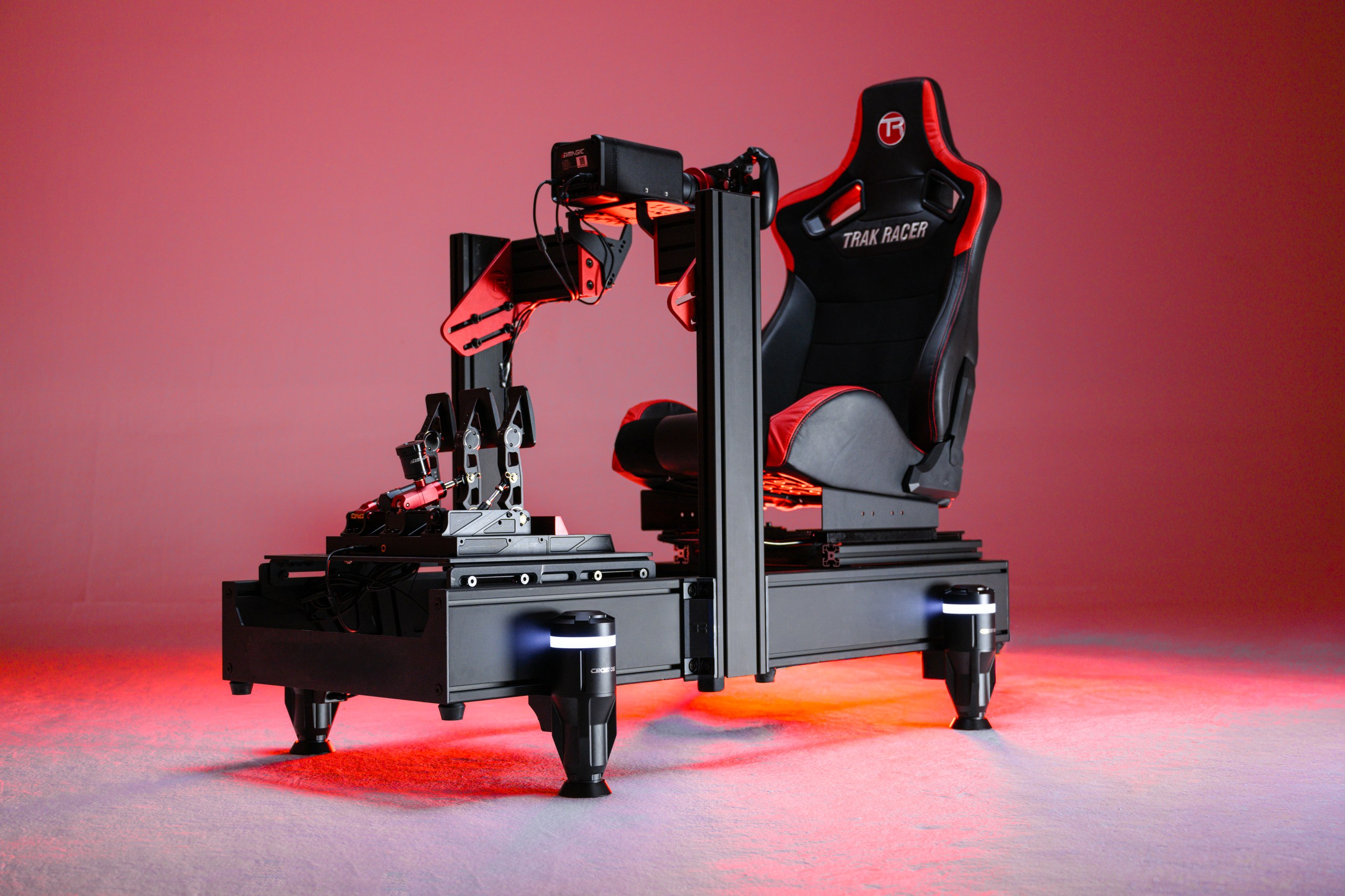
For years, sim racing motion has been sold on a single number: travel. Bigger platforms, longer throws, more degrees of pitch and roll. The pitch is intuitive, more movement must mean more realism. Spend a season actually driving on motion, and you learn the opposite. What makes you faster is not how far the cockpit moves. It is how accurately it tells you what the car is doing, and how quickly.
D Force 1 is built around that hard-won lesson. It is a deliberate bet that in a home cockpit, precision beats amplitude, and that bet changes what motion is for.
A big-throw platform spends most of its effort simulating sustained acceleration by tilting you back and leaning on gravity. It can be convincing for a second, but it is slow, it is coarse, and it uses up its range on the low-frequency stuff while smearing the details that actually matter. The moment the rear steps out, or a kerb bites, or the fronts lock under trail braking, those are fast, small, high-information events. A platform optimized for large slow movements tends to blur them into one vague wobble.
The result is motion that feels dramatic in a showroom and vague at racing speed. You feel that something happened, not what happened. And "what happened" is the entire point. It is the difference between catching a slide and spinning.
Each of the four actuators runs a 50 mm stroke across a 0-100 Hz frequency range, with up to 180 kg of lift per axis to move a loaded cockpit without sagging. Fifty millimetres sounds small until you feel it. Short, tightly controlled travel resolves the events that make you quicker (the edge of a kerb, grip breaking away, weight transferring under braking) instead of throwing the whole rig around and hoping you infer the rest.
The frequency range is where the realism actually lives. Low frequencies carry load and slides; high frequencies carry surface texture, kerbs, and lock-ups. A wide, honest 0-100 Hz range keeps those separate, so a curb strike reads as a curb strike and tyre scrub reads as tyre scrub, rather than collapsing both into a single buzz. You stop guessing and start reacting.
This is not less motion. It is motion aimed at the part of the signal your body uses to drive.
None of this comes from a spec sheet. D Force 1 is developed and tested by drivers competing at the front of the field, 8,000+ iRating, running 24-hour endurance events like Spa. Every effect is tuned against what a real stint actually feels like: how the car loads mid-corner, what a missed apex does to the platform, how the rear telegraphs a snap before it lets go. When the people building the hardware are the same people trying to win races on it, the tuning target stops being "impressive" and becomes "correct."
That is the quiet advantage. A lot of motion is engineered to demo well. D Force 1 is engineered to be driven well, over long races, by people who will notice if it lies to them.
The game-changer is not a single feature. It is a change in priorities. D Force 1 gives up the theatre of big travel in exchange for speed, accuracy, and detail, the things that make motion a tool for driving faster rather than a novelty you stop noticing after a week. It fits the rig you already own, it installs in an afternoon, and it earns its place not by moving the most, but by telling you the most.
Precision over amplitude. Once you have driven it, the old way of measuring motion stops making sense.
CircuitOne sells through authorized distributors. Contact us and we will connect you with the closest one.